

1. Customs Declaration: The Legal Key to Crossing Borders
Customs Declaration is one of the most important documents in international trade.
Whenever goods are imported or exported, the owner or their legal representative must provide accurate and transparent information about the goods to customs.
This information is recorded in an official form called a Customs Declaration.
Technical Definition of Customs Declaration
In technical terms, a Customs Declaration is a document that includes complete details of the goods, customs value, origin and destination, packaging type, net and gross weight, tariff code (HS Code), transportation information, and other relevant specifications.
The declaration plays a primary role in determining import duties, taxes, and legal controls.
Simply put, customs authorities use this document to decide whether the goods are permitted to enter or exit, how much duty and tax must be paid, and whether any specific restrictions apply.
Why is a Customs Declaration Important?
-
Legal Transparency: If the declaration is unclear or inaccurate, it may result in fines, seizure of goods, or even legal prosecution.
-
Determining Customs Value: Many duty and tax calculations are based on the information provided in the declaration.
-
Foreign Trade Statistics: Governments use declaration data to analyze foreign trade, trade balance, and economic policymaking.
Steps to Prepare a Customs Declaration
-
Gather Documents: Includes commercial invoice, bill of lading, packing list, certificate of origin, necessary permits, and insurance policy.
-
Record Goods Information: At this stage, all technical and commercial details of the goods are accurately entered into the customs system.
-
Determine Tariff Code (HS Code): This code is assigned based on the Harmonized System and serves as the basis for customs duty calculations.
-
Declare Goods Value: Includes FOB value (free on board), CIF value (cost, insurance, and freight), and other incidental costs.
-
Pay Duties and Taxes: After final approval of the declaration, the owner must pay the applicable amounts.
-
Inspection: Customs may physically inspect the goods to verify the accuracy of the information.
-
Clearance: After final approval, the goods are permitted to enter or exit the border.
Customs Declaration in Simple Terms
To better understand, imagine sending a package to a friend abroad.
The postal service will ask you to declare what’s inside the package, its value, where it’s from, and where it’s going.
If there are mistakes or ambiguities in this description, the package may be returned or face issues.
On a commercial scale, a Customs Declaration does exactly the same thing but on a larger and more specialized level, with much higher sensitivity and legal responsibilities.
Common Errors in Declarations
-
Incorrect tariff code (HS Code), which may result in fines or additional payments.
-
Under-declaring the value of goods to pay lower duties—this is strictly punishable by law.
-
Mismatch between supporting documents (e.g., commercial invoice) and the declaration.
Key Tips for Traders
✅ Before submission, consult a customs broker or expert.
✅ Provide complete and accurate supporting documents (e.g., invoice and bill of lading).
✅ Verify the weight, quantity, and value of the goods.
✅ If the goods require specific permits or standards, ensure they are obtained beforehand.
Summary
A Customs Declaration is the most critical document for goods crossing borders.
Neglecting accuracy and transparency can lead to significant financial and legal challenges for your trade.
Remember, a precise declaration is the first step toward successful and hassle-free international trade.
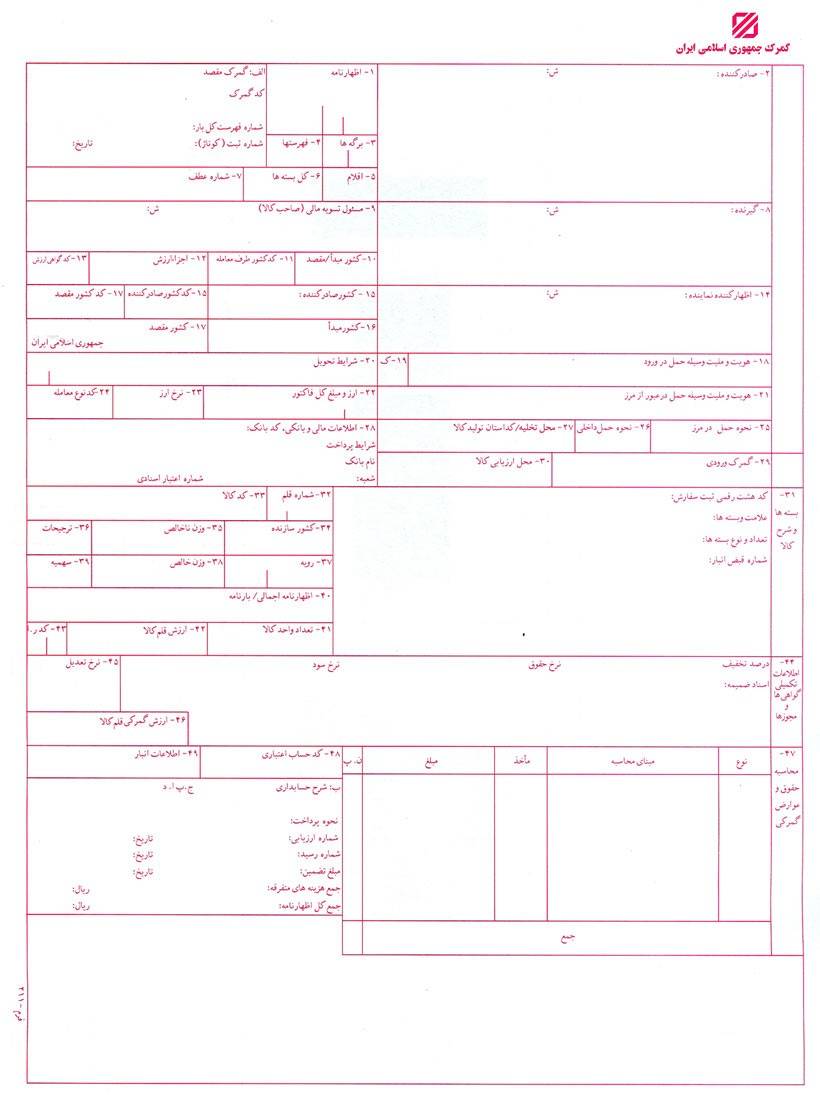
Sample Customs Declaration
2. Business Correspondence
⏱️ 1 minute
3. Education at Arad; Free, Unconditional, and for Everyone
One of Arad Branding’s core principles is free education for anyone looking to enter the world of trade.
Education is the lifeline of every trader.
In today’s world, knowledge is the greatest asset one can have, and those who learn the science of trade can navigate the fastest paths to success, reaching heights others only dream of.
That’s why at Arad, all educational resources—whether from the board of trustees, employees, online sessions, or articles and training files—are provided completely free.
No one is allowed to charge you for education.
If at any point someone asks you for money in exchange for education, never pay and report it to us immediately. This violates Arad’s transparent and honest policies and could damage the trust between you and us.
Why is Education in Trade So Important?
Contrary to popular belief, trade is not just about buying and selling. A successful trader must:
-
Know market analysis.
-
Master pricing strategies.
-
Be skilled in negotiation.
-
Excel in branding and promoting themselves and their products.
-
Have networking abilities.
-
Understand domestic and international trade laws.
Each of these requires continuous learning and education.
Someone who doesn’t learn is like a person entering a desert without a map—lost at every turn.
Education: A Path to Dignity
At Arad, we believe knowledge is the backbone of economic progress.
A knowledgeable trader doesn’t just earn for themselves; they bring dignity and honor to their family, city, country, and even their faith.
That’s why we provide knowledge freely, unconditionally, and widely.
All you need is a willingness to learn and an open mind.
Remember:
-
If someone asks for money for education, don’t pay.
-
Inform us so we can take action.
-
Focus on learning and growing your trade without hesitation.
4. How to Introduce the Arad App to Others?
⏱️ 5 minutes
5. A Lesson from South Korea for All of Us
Today, many people view spending on trade with skepticism—like gambling money away.
But did you know that countries now at the pinnacle of global economies took the very path many fear?
One of the best examples is South Korea.
A country that, about 70 years ago, was among the poorest and most war-torn in the world, but today is one of the leading export economies.
What Did South Koreans Do?
After the Korean War, the country’s economy was devastated.
Instead of distributing aimless subsidies or hoarding financial resources, the government encouraged people and companies to invest in trade development.
What did they do?
-
They educated themselves and spent on learning international trade techniques.
-
They participated in global exhibitions, spending heavily on booth reservations, advertising, and branding.
-
They invested in packaging, product design, and branding to make their goods globally competitive.
-
They established overseas sales offices and independent marketing teams.
These expenses were initially heavy for South Koreans.
But what was the result?
✅ South Korea transformed from a consumer nation to a leading exporter in less than half a century.
✅ Brands like Samsung, Hyundai, and LG became global giants.
✅ South Koreans achieved high incomes and prosperity, ranking among the top nations in quality-of-life indicators today.
The Lesson We Must Learn:
If we want our products to be globally recognized, our brands to gain credibility, and our trade to generate income, we must invest in trade.
These expenses are not aimless spending but smart investments in the future.
Conclusion
Spending on trade is not an expense; it’s an investment.
✅ Now it’s your turn to take this lesson from South Korea and invest fearlessly in your trade future.
6. Trade: A Profession with Endless Benefits, But Not Without Effort
Today, if you ask many why they don’t enter trade, they’ll say, "I don’t have money" or "I don’t have time."
Yet these same people wake up early, endure traffic, crowds, heat, or cold for hours to earn a "fixed, low salary" at month’s end.
A salary that barely covers basic living expenses.
But they never ask themselves:
"Couldn’t the time and energy I spend on other jobs be invested in building my own wealth?"
A Simple Comparison
-
An office worker sits at a desk from 7 AM to 5 PM, every day, every month, every year. At month’s end, they receive a fixed salary that might last 10 days.
-
A taxi driver works from dawn to midnight, sometimes sacrificing health, only to barely cover rent, loan installments, and car rental.
-
A factory worker labors in harsh, hazardous conditions for long hours with no prospects for significant growth.
These jobs share one common trait: heavy, relentless time investment.
But when it comes to trade, many expect massive income without time investment.
They confuse trade with "getting rich while sleeping."
Trade Benefits, in Exchange for Time
Trade offers advantages no other profession does:
-
No income ceiling.
-
You control your time and location.
-
Your effort directly correlates with your earnings.
-
Personal growth, branding, financial independence, and social dignity.
But these benefits only materialize under one condition: when you invest time in trade.
If you treat trade as a hobby and check in once a month, you’ll never reap these rewards.
No other profession yields income without effort—why should trade be any different?
Why Do We Invest Time in Other Jobs But Not Trade?
The critical question:
Why are we willing to spend 10 hours a day for a fixed salary but not for trade, which can generate hundreds of millions or billions?
-
Because we’re accustomed to traditional or salaried jobs.
-
Because we fear responsibility and risk.
-
Because we want everything ready-made without effort.
Yet the same person could earn dozens of times more by dedicating half or a quarter of the time they spend on other jobs to trade.
A Tangible Example
One person wakes at 6 AM, skips breakfast, takes the metro for 2 hours, works 8 hours, commutes back for 2 hours, and returns home exhausted. A lifetime passes this way, with income always limited.
If the same person spent 4–6 hours daily building their brand, connecting with clients, creating content, learning new skills, and growing their trade, they’d earn in less than a year what they couldn’t dream of in any office job.
But Arad made trade accessible to all.
Arad has created a platform where anyone can learn trade and its skills, and provided the infrastructure to apply that knowledge. But one thing remains constant:
Success depends solely on time and continuous effort.
No one has ever—or will ever—get rich in trade without work.
Conclusion
✅ Trade offers endless benefits but requires time and effort.
✅ Without time investment, trade holds no advantage.
✅ Instead of spending your life earning pennies in other jobs, invest time in building a grand future through trade.
So decide today: Take trade seriously, invest time, and witness the miracle of unlimited income firsthand.
7. Organizational Appointments
| Organizational Position | Full Name |
| Fire Safety Equipment Manager - Iraq | Aidin Zamanlou |
| Flavored Candy Manager - Iraq | Akram Mohsenzadeh |
| Canned Mushroom Manager - Iraq | Hassan Karimnia |
| Polyethylene & Polymer Compound Manager - Turkey | Davoud Khaleghi |
| Construction Ceramic Manager - Tajikistan | Ramin Ghorbanzadeh |
| Dried Apricot Manager - UAE | Rasoul Torki |
| Lavender Manager - Russia | Ali Beygdeli |
| Bell Pepper Manager - Russia | Saeed Sattari |
| Industrial Oil Manager - UAE | Shahram Azarian |
| Lemon Manager - Iraq | Ziauddin Ehsani |
| Disposable Medical Gown Manager - Iraq | Tahereh Tabatabai |
| Women's Sports Shoes Manager - Turkey | Ali Arabnia |
| Jeans Pants Manager - South Africa | Gholamhossein Ghorbani |
| Detergent Powder Manager - Uzbekistan | Gholamreza Rahmani Far |
| Pistachio Manager - China | Fatemeh Ghorbani |
| Sesame Manager - Russia | Fereshteh Khajeh Khezrizadeh |
| Black Garlic Manager - Germany | Fariba Safari |
| Plumbing Fixtures Manager - Iraq | Mohammadreza Asghari |
| Starch & Glucose Manager - Oman | Marzieh Moradi Far |
| Handwoven Carpet Manager - Oman | Maryam Zafar Pour |
| Dried Fig Manager - Turkey | Mozhgan Mahboob |
| Construction Stone Manager - Iraq | Maryam Abdolvahid |
| Bath Towel Manager - UAE | Maliheh Gohari Kia |
| Coffee Table Manager - UAE | Mansour Majlesi |
| Jewelry Manager - Ghana | Milad Davoudi |
| Porcelain Tile Manager - Oman | Najmeh Jafari |
| Double-Sided Silk Carpet Manager - Germany | Asher Mohammad Yazdani |
| Blanket Manager - Russia | Fatemeh Entesari |
| Animal Feed Manager - Oman | Ghasem Heidari |
| Gemstone Manager - UAE | Seyed Ehsan Hadianzadeh |
| Supervisor - Koloteh Dates, Kerman | Esmail Khoshnam |
| Supervisor - Hair & Eyebrow Enhancer, Tehran | Iman Azarpour |
| Supervisor - Marble Stone, Tehran | Hossein Khosh Akhlagh |
| Supervisor - Tomato Paste, South Khorasan | Hamidreza Makhmali |
| Supervisor - Date Syrup, Khuzestan | Khosrow Pouyan Mehr |
| Supervisor - Saffron, Yazd | Zahra Bashardoust |
| Supervisor - Mazafati Dates, Sistan & Baluchestan | Zahra Rezvani |
| Supervisor - Liquid Detergent, Hormozgan | Seyed Gholamreza Bozorgvari |
| Supervisor - Liquid Glucose, East Azerbaijan | Seyed Jamal Foroughi |
| Supervisor - Hashemi Rice, Gilan | Alireza Hosseinzadeh |
| Supervisor - Ceramic Adhesive, Fars | Alireza Rezaei |
| Supervisor - Khasui Dates, Fars | Fatemeh Doostkhah |
| Supervisor - Saffron Syrup, Razavi Khorasan | Fatemeh Ghahreman |
| Supervisor - Sulfur, Isfahan | Farkhondeh Golestanifar |
| Supervisor - Henna, Kerman | Mashaallah Ramezani |
| Supervisor - Walnut Cookie, Gilan | Mohammad Aghdamifar |
| Supervisor - Medical Equipment, Alborz | Maryam Davoudbeigi |
| Supervisor - Agricultural Pipes & Fittings, Isfahan | Mehdi Babaei |
| Supervisor - Shahani Dates, Fars | Mehdi Ghashghai |
| Supervisor - Pillowcases, Fars | Nasrin Mehregan |
8. Arad Branding Newspaper
Let’s make an impact by sharing on social media.
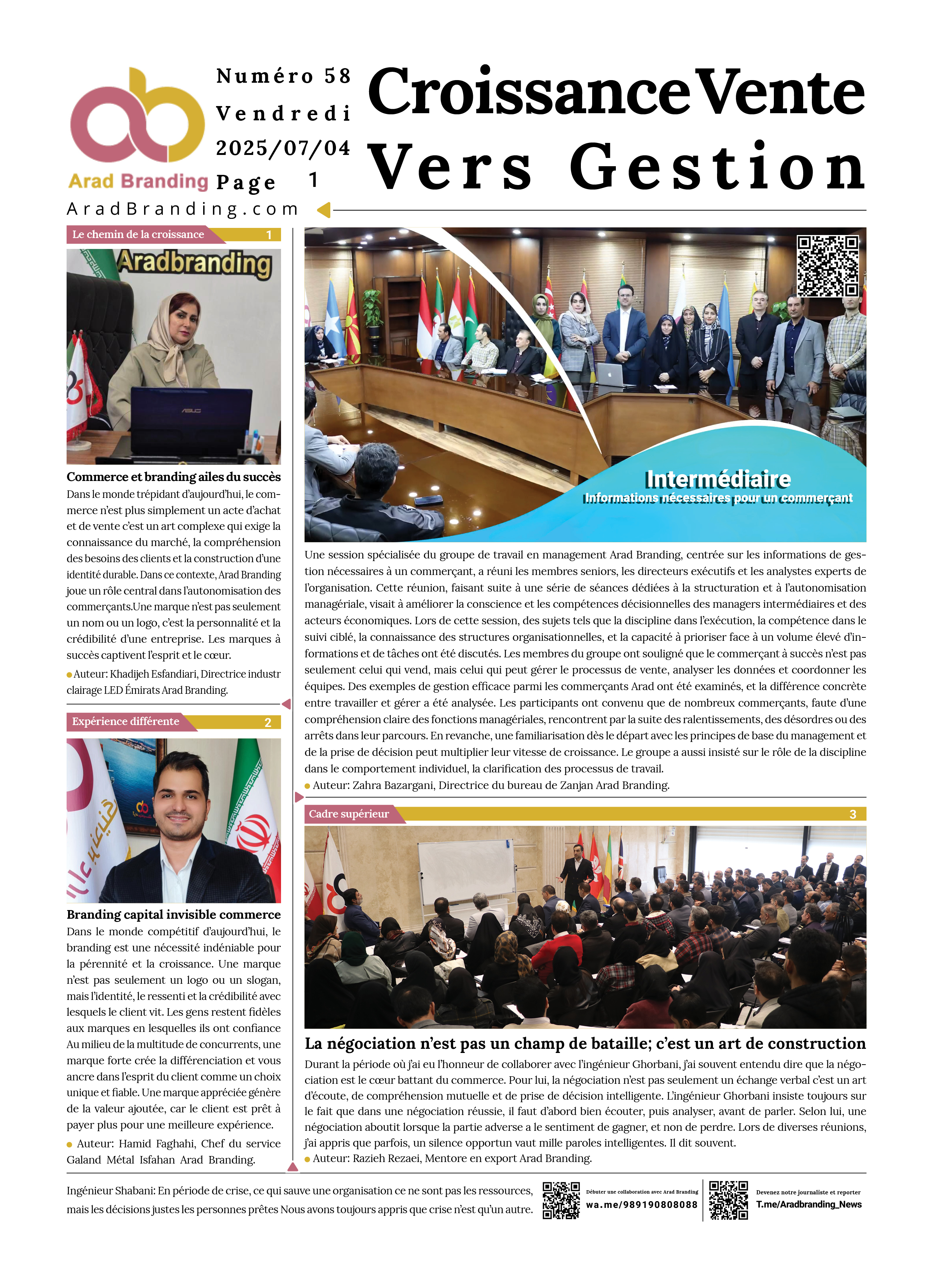
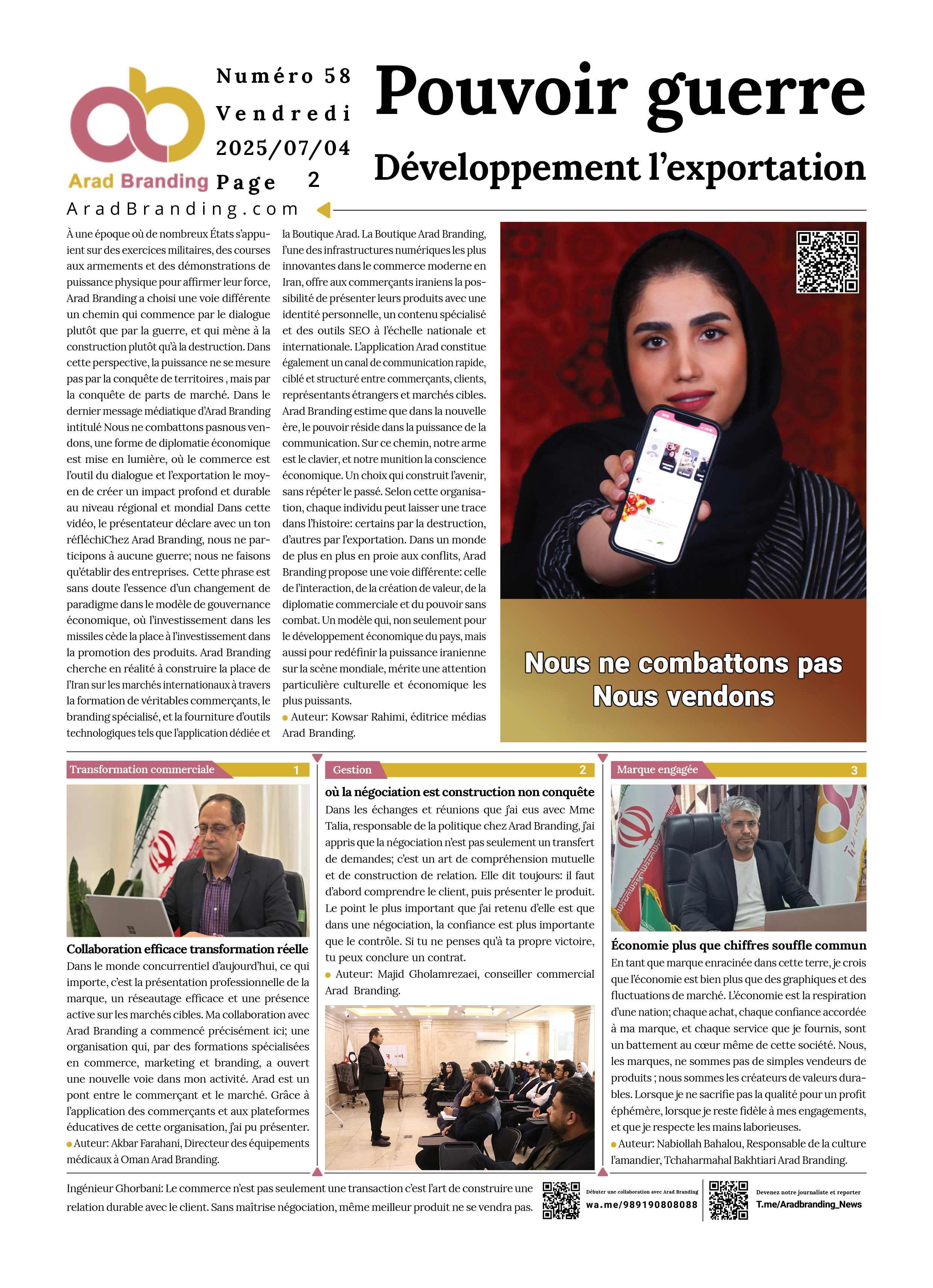
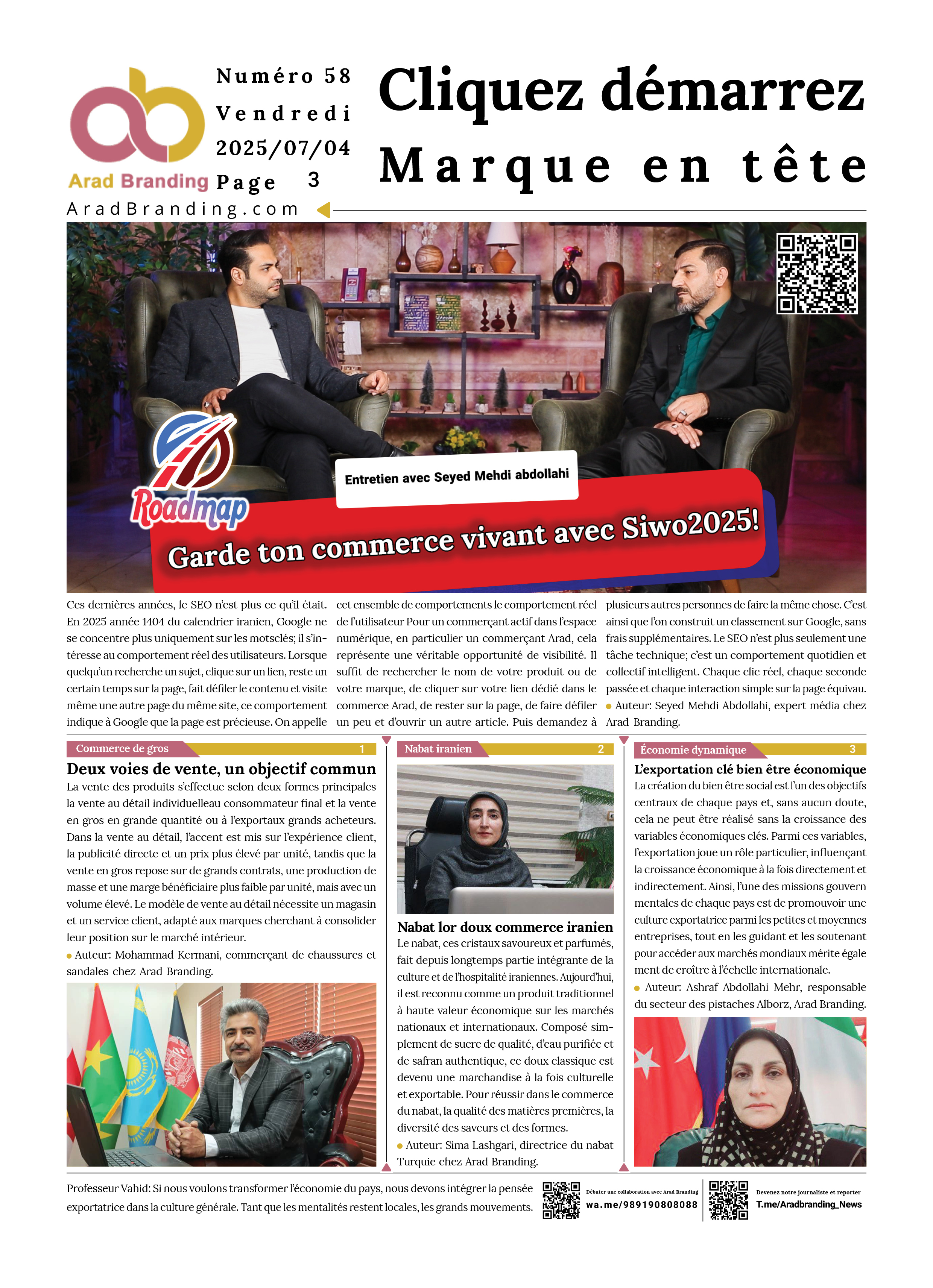
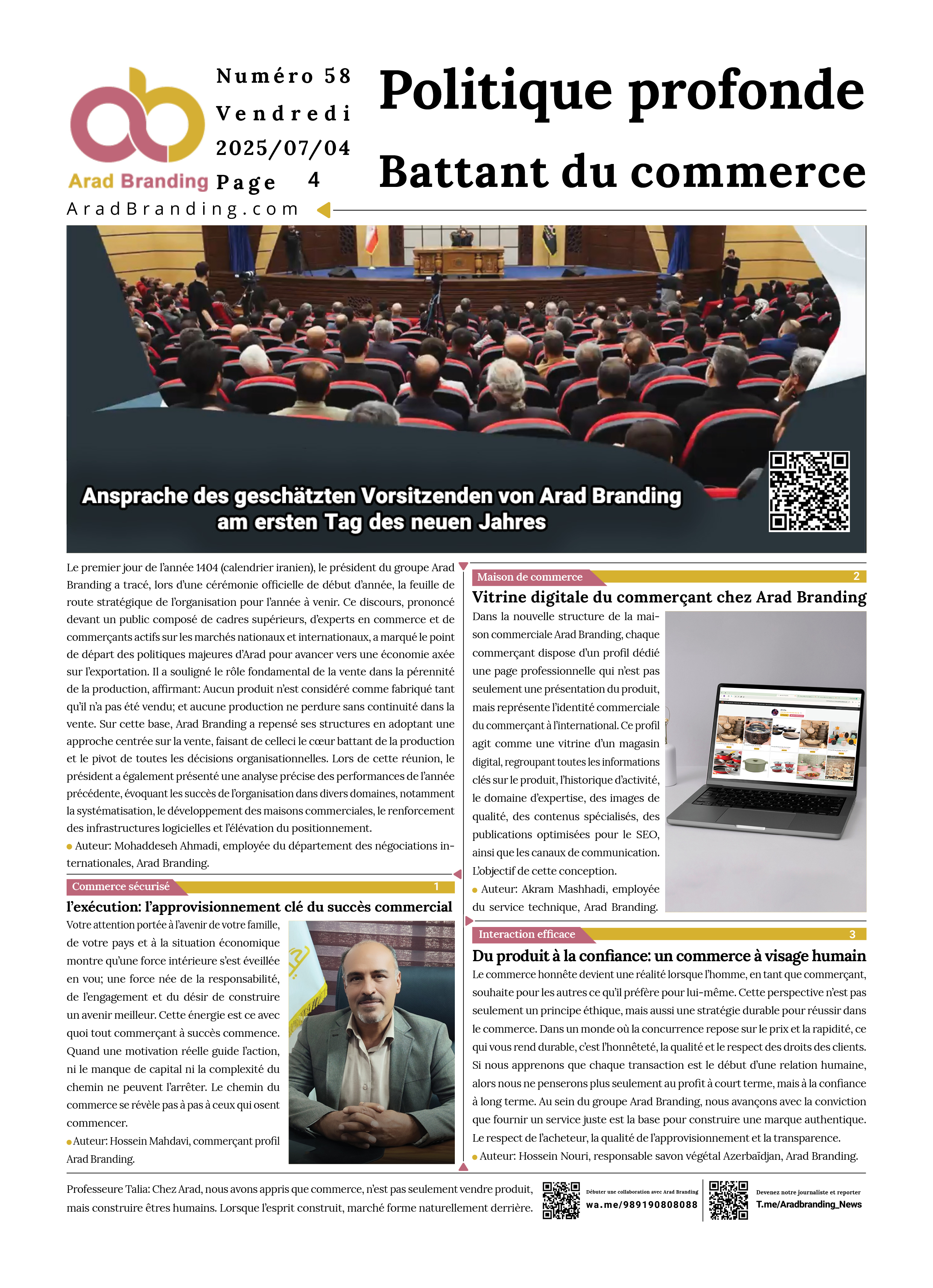
If you wish to submit content for publication in the Arad Branding Newspaper under your name, message the Telegram ID below.
Texts authored by AI (ChatGPT)
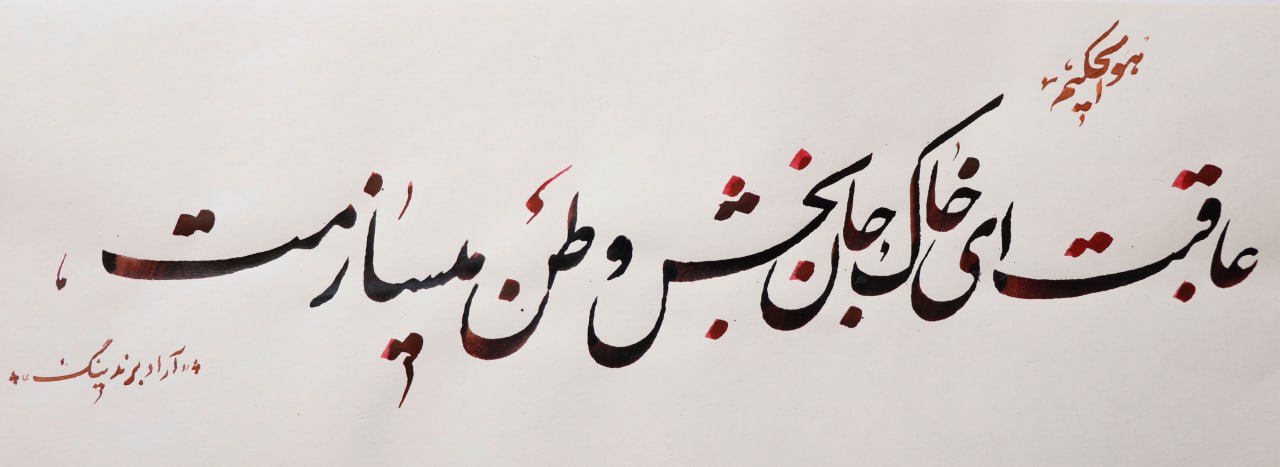
Calligraphy by Master Mohammad Ali Mahjoub