

1. How can a merchant source the goods they need?
One of the most important concerns for every merchant, after finding customers and establishing connections, is:
"Now where and how can I source this product?"
If this question is also on your mind, you should know that not only you but all merchants face this question at the beginning of their journey.
But fortunately, there is a solution.
A clear, precise, and tested path.
What does sourcing goods mean?
Sourcing goods in trade means finding a reliable source for producing, purchasing, or obtaining the product you want to sell to your customer.
The sourcing source can be a factory, manufacturer, wholesaler, farmer, importer, or official intermediary.
The ultimate goal of sourcing is to be able to provide the product:
-
At a competitive price
-
With reliable quality
-
On schedule
-
And in the volume required by the customer, prepare and deliver on time.
Steps for merchants to source goods
1. Identifying domestic and local sources
The first and fastest method is finding suppliers within the country.
For this:
-
Think of industrial or agricultural cities related to your product.
For example, Rafsanjan for pistachios, Qaen for saffron. -
Use Google, Instagram, domestic B2B websites, Telegram, and WhatsApp Business.
-
Visit specialized exhibitions.
-
Refer to the Chamber of Commerce and related unions in each province.
-
Connect with the Sourcing Department of Arad Branding, which has a vast network of producers and can provide it to you.
Important: Make initial contact via phone call, and then request photos, videos, or samples to confirm quality.
2. Finding factory owners and primary producers
Some goods must be obtained directly from the factory or producer to get a lower price.
-
You can get leads from websites like Iran Tejarat, Saran Tejarat, or Sanatban.
-
Inquire at wholesale markets in major cities like Tehran, Tabriz, Mashhad, Isfahan.
-
Directly visit the Industry, Mining, and Trade Organization of provinces to get a list of official producers.
Important note: Talk to several producers to compare rates and build trust.
Don't work with just one person unless after several successful orders.
3. Professional negotiation for sourcing
Negotiation with suppliers should be done with awareness.
In negotiations, you should specify:
-
What is your order volume?
-
Is payment cash, check, or on consignment?
-
Who covers transportation costs?
-
Is branding/packaging with your brand possible?
-
What guarantees do they have for delivery delays or quality discrepancies?
If you're new to negotiation, seek help from the Sourcing Department at Arad Branding.
4. Using the Arad network for sourcing
Other merchants in Arad Branding are a great resource for sourcing.
Just:
-
Join the Board of Trustees meetings for provinces.
-
Join the sourcing channel.
-
Register your request for sourcing the desired product.
Sometimes a higher-promotion merchant can provide you with sourcing or source the product for you so you can focus on sales.
5. Signing a contract or written agreement
Even if you find a very good and reliable supplier, always sign at least a written agreement that includes:
-
Names and contact numbers of both parties
-
Detailed product specifications
-
Price, delivery date, delivery location
-
Penalties for delays or quality reduction
-
Payment and settlement method
This protects you against any breach of promise.
6. Re-evaluation after each sourcing
After each sourcing transaction, check:
-
Was the product quality good?
-
Was the timing adhered to?
-
Was your profit adequate?
-
Was the customer satisfied?
This evaluation helps you keep the best sources for next time and eliminate weak ones.
Final summary
🔹 Sourcing goods is not an obstacle but an opportunity to build powerful business connections.
🔹 Just be precise, persistent, smart, and organized.
🔹 If you have trouble with sourcing, don't feel alone because at Arad Branding, the Sourcing Department, Board of Trustees, and other merchants can help you.
If you want, you'll find a way; if you don't, you'll find excuses.
And someone who wants to be a merchant must learn sourcing skills alongside sales.
At Arad Branding, no merchant at any promotion level will have sourcing problems, provided they are persistent, concerned, take serious actions through the mentioned paths, and are patient in this journey.
2. We grow the trading house together.
⏱️ 1 minute
3. Everyone in trade searches your name.
In the business world, your "name" is everything.
When a potential customer or business partner decides to work with you, what's the first thing they do?
Check your profile and bio on social media and search your name on Google.
But when they search your name, if others with similar names appear in the top results and you're lower down, what happens?
Exactly here, trust is lost, and golden business opportunities are destroyed.
If you're a merchant, you must ensure your name appears at the top of Google search results.
Why is it important for your name to appear first?
- Because the first thing a customer sees is their basis for judgment.
- Because a customer's mind builds trust based on your visibility.
- Because if your name is lower than others, you seem obscure, unreliable, and weak to the customer.
- Because high sales come from high trust.
Is it really hard to spend just 10 minutes a day on your name and reputation?
Isn't it a shame to lose customers just because of indifference to search and clicks?
If you want your business to thrive, first make sure that when your name is searched, only one person appears: you.
4. Aradis in the field
⏱️ 2 minutes
5. A merchant must always be accessible.
In business, accessibility means the difference between having a customer and being lost in silence.
A real merchant must always be reachable by phone and internet.
Even if there's an internet issue, you must knock on every door to get back online.
Let's examine with 6 scientific and logical reasons why responding to calls and messages must become a habit for all Arad and non-Arad merchants:
1. Quick trust – the first capital
Studies show that easy accessibility increases "trust and credibility".
If you're not responsive, customers will look for more accessible options everywhere.
2. Reducing missed opportunities = retaining potential customers
Every unanswered call or message means a lost potential customer.
Research says: "Sales opportunities disappear when you're not accessible."
3. Feeling valued – creating lasting relationships
When you're responsive, customers feel "important to you".
This behavior builds loyalty.
Long-term, it leads to repeat purchases and word-of-mouth advertising.
4. Increasing Google ranking (local SEO)
Google analyzes user behavior; if customers open your page, stay, or click, your search ranking rises.
This means more visits and increased sales.
5. Unknown caller = future customer
Don't ignore calls from unknown numbers; it could be an investor, partner, or big customer.
Research shows such accessibility builds more credibility and opens the customer's mind to the merchant.
6. Competitiveness in the age of instantaneity
In today's market, customers expect responses within hours.
Studies show lack of quick response makes users leave and choose other options.
✅ Conclusion: The red line of being a merchant
-
If you don't answer calls, you're saying: "I'm not a serious merchant."
-
If messages go unanswered, you're losing a large portion of your customers.
-
If your phone is off for days, you've practically shut down your business.
📌 Practical solutions:
-
Keep your phone always on, and if an unknown number calls, answer quickly.
-
If you're somewhere without internet, inform others or announce when you'll be back online, and don't let your offline time exceed 24 hours.
-
Quickly check missed calls and messages, and even if you don't have an immediate answer, call back.
-
If you're traveling or on leave for a while, quickly arrange a substitute so customers don't feel fear or indifference.
In the business world, being accessible is a sign of professionalism.
It's a simple but effective principle: be accessible so people can see you, know you, and trust you.
In this fast and competitive space, there's no room for carelessness; only a real merchant can always be online, responsive, and stay ahead.
The same topic from another angle
In today's world, a professional merchant is someone who is responsive, accessible, and present at all times.
Lack of responsiveness or effective presence will not only not bring success in business but can also cause significant losses.
Next, we examine the most important reasons why your phone should always be active and messages should be answered:
1. Instant trust-building
If a customer doesn't get a response to your call or message, doubt arises in their mind. Research shows that 57% of users lose their trust in the first minute of waiting. A serious merchant must have 24/7 presence to build initial trust in their ability and accountability.
2. Instant opportunities come alive.
In business, opportunities come suddenly and unexpectedly: a message from a foreign party, an instant order, or an urgent request! A quick response within 15 minutes increases the chance of closing a deal by 5 times.
3. Addressing customer concerns and brand credibility
If a customer leaves a message and gets no response, their trust is shaken. This behavior negatively impacts your personal brand. Research shows 80% of negative communication events are due to delay or lack of response.
4. Advantage over competitors
If you're responsive and your competitor isn't, the customer prefers to work with you. Consider: if only 20% of merchants respond quickly, you'll automatically be in this top group and attract more profit.
5. Powerful networking and professional credibility
A merchant who remains obscure loses the start of connections. But a responsive individual is recognized as trustworthy in others' minds. Studies show that even one unanswered call can reduce connection chances by 60%.
6. Alignment with modern business principles
In the age of "instant commerce," it's essential to be accessible on all platforms (WhatsApp, Telegram, Instagram, dedicated app...). Constant presence shows respect for the customer and prioritizes them.
🔧 Practical solution for a professional merchant:
-
📱 Phone always with you, to answer unknown calls or urgent messages.
-
⏱ Standard response time: under 15 minutes; if you can't immediately, send a short message saying you'll respond soon.
-
🌐 Diverse network: Being active on multiple channels (WhatsApp, Telegram, app) increases connection chances.
-
🗓 Weekly schedule: Monitor phone status, check messages, remind yourself of calls to make.
-
📈 Impact monitoring: Monthly, create a communication table: how many calls made, messages sent, orders received? This keeps you motivated to continue.
Logic and external credibility
-
According to HubSpot research, a quick response within 15 minutes leads to closing 5 times more leads.
-
A Salesforce report shows that 80% of users expect immediate responses and lack of response "drastically increases customer churn."
-
An article from MIT emphasizes: "In digital commerce, 'being accessible equals credibility'."
Conclusion
A real merchant distinguishes themselves by being accessible and responding quickly.
This simple but powerful behavior smooths the business path and keeps connections alive.
Someone who has no internet for days or ignores calls shows they're not serious and naturally won't achieve results in business.
So keep your phone always online, respond, follow up, and shape your business with trust and speed.
6. You built your shop, now show it to everyone.
⏱️ 3 minutes
7. Until you shout that you're a merchant, you won't become one.
In today's world where digital communication is paramount, each person's profile is their showcase.
This showcase must not only be full of identity and personality but must shout, "I am a merchant."
But unfortunately, many newcomers to the business world still hesitate to declare this openly.
Why?
Because they fear ridicule from family, friends, acquaintances, or even neighbors.
Because they say, "When I succeed, then I'll say I'm a merchant."
But the problem is exactly here.
Until their profiles take on the color and scent of business, no customer takes them seriously.
No negotiation forms.
No collaboration is born.
So not only do they not progress, but they remain stuck in a cycle of fear and procrastination.
A merchant's profile must "shout" that I'm a merchant
First, you must shout, then they'll hear.
First, you must announce your presence, then they'll come to you.
When a customer opens your profile, if there's no suitable professional photo, if your WhatsApp bio doesn't mention Arad Branding, if there's no sign of business, they'll say to themselves:
This person is unclear! So they move on.
And this opportunity is lost.
Your business profile must contain these 3 principles:
-
A clear and professional image of yourself, especially in a formal setting with a business flag.
-
A clear and formal bio including your position at Arad Branding.
-
Daily stories about business, products, and website content.
Where does the fear come from?
Those who say, “Let me succeed first, then I’ll call myself a businessman,” are like someone who says:
-
Let me get slim first, then I’ll go to the gym.
-
Let me get good grades first, then I’ll study.
-
Let me see Heaven first, then I’ll pray.
-
Let me earn money first, then I’ll build my brand.
All of these are examples of a reversed view of the path to success.
God is where His servant expects Him to be.
According to a Divine Hadith:
"I am as My servant thinks of Me, so let him think of Me as he wishes."
(I treat My servant as he expects from Me.)
📚 Sahih Bukhari, Volume 9, Hadith 7405
This means if a person is certain of success, God places him on the path of success.
But if there’s fear, doubt, or self‑censorship in his heart, God blocks the way too.
What does the Quran say?
In Surah Inshirah, God says:
Indeed, with hardship comes ease.
This means: first comes the struggle, first raise your voice, throw away the fear, and then ease will arrive.
God never said: first comfort, then effort.
That logic belongs to the fearful — and a fearful trader is deprived and without sustenance.
A believer is one who trusts God's promise and takes action, even if mocked at first.
Put fear aside, start trading
If you haven’t yet written “Export Manager of [product] at Arad Branding” in your social media profile, if you haven’t posted a professional work photo, if you haven’t declared in stories and posts that you're a trader, then you don’t even believe in your own trade.
And if you don’t believe it, no one else ever will.
Final Conclusion
All successful traders started from one point: declaring that they are traders.
They weren’t afraid of family or failure. They stood firm in their belief and will — and the world stood in front of them.
If you want to succeed, today, right now, change your profile.
Professional photo, formal bio, links to your pages, commercial stories, and posts that show you as a serious trader.
Learn this: if you don’t say you're a trader, you’ll never become one.
8. Why not export?
⏱️ 2 minutes
9. Appointment of Organizational Roles
| Organizational Position | Full Name |
| Director of Water Purifier Device – Nigeria | Babak Nazari |
| Director of Sumac – Austria | Baratali Mohammadi |
| Director of Asafoetida – UAE | Parvin Rajabi |
| Director of Herbal Moisturizer Cream – Iraq | Parvin Nakhaei |
| Director of Water Purifier Device – Iraq | Pouneh Seifai |
| Director of Hygienic Detergent – Oman | Hossein Kordbacheh |
| Director of Meat and Extract Paste – Iraq | Reza Asoudeh |
| Director of Plastic – Iraq | Saeed Chalak |
| Director of Oranges – Russia | Arash Mahmoudinia |
| Director of Kitchen Plastic Products – Iraq | Abulfazl Sahami |
| Director of Citric Acid – USA | Saeed Borhani |
| Director of Olives – Iraq | Manouchehr Allahbakhshi |
| Director of Royal Furniture – Saudi Arabia | Mansour Ghezelchi |
| Director of Steel Pipe & Profile – Afghanistan | Ali Sheikh Abumasoodi |
| Head of Fars Agate Stone – Iran | Mohammad‑Hassan Vahidi |
| Head of Kitchen Plastic Products – Tehran | Abulfazl Sahami |
| Head of Bitumen – Tehran | Sediqeh Gholipour |
| Head of Jeans – Qom | Fouzieh Sahraei |
| Head of Sugar Candy – Tehran | Zahra Borji |
| Head of Olive Oil – Qazvin | Manouchehr Allahbakhshi |
| Head of Almond – Alborz | Zari Yekeh Fallah |
| Head of Steel – West Azerbaijan | Amir Azimzadeh |
| Head of Detergent Powder – West Azerbaijan | Parvaneh Abubakri |
| Head of Rose Water – Tehran | Parvin Rajabi |
| Head of Men's Sports Shoes – Tehran | Habib Pour Heidari |
| Head of Chicory Distillate – West Azerbaijan | Hamid Fotouhi |
| Head of Mazafati Dates – East Azerbaijan | Ali Ghasemzadeh |
| Head of Akbari Pistachio – Alborz | Alireza Dehaz |
| Head of Frozen Fruit – Tehran | Noushin Shoja |
10. Arad Branding Newspaper
Let’s create a movement by publishing on social media.
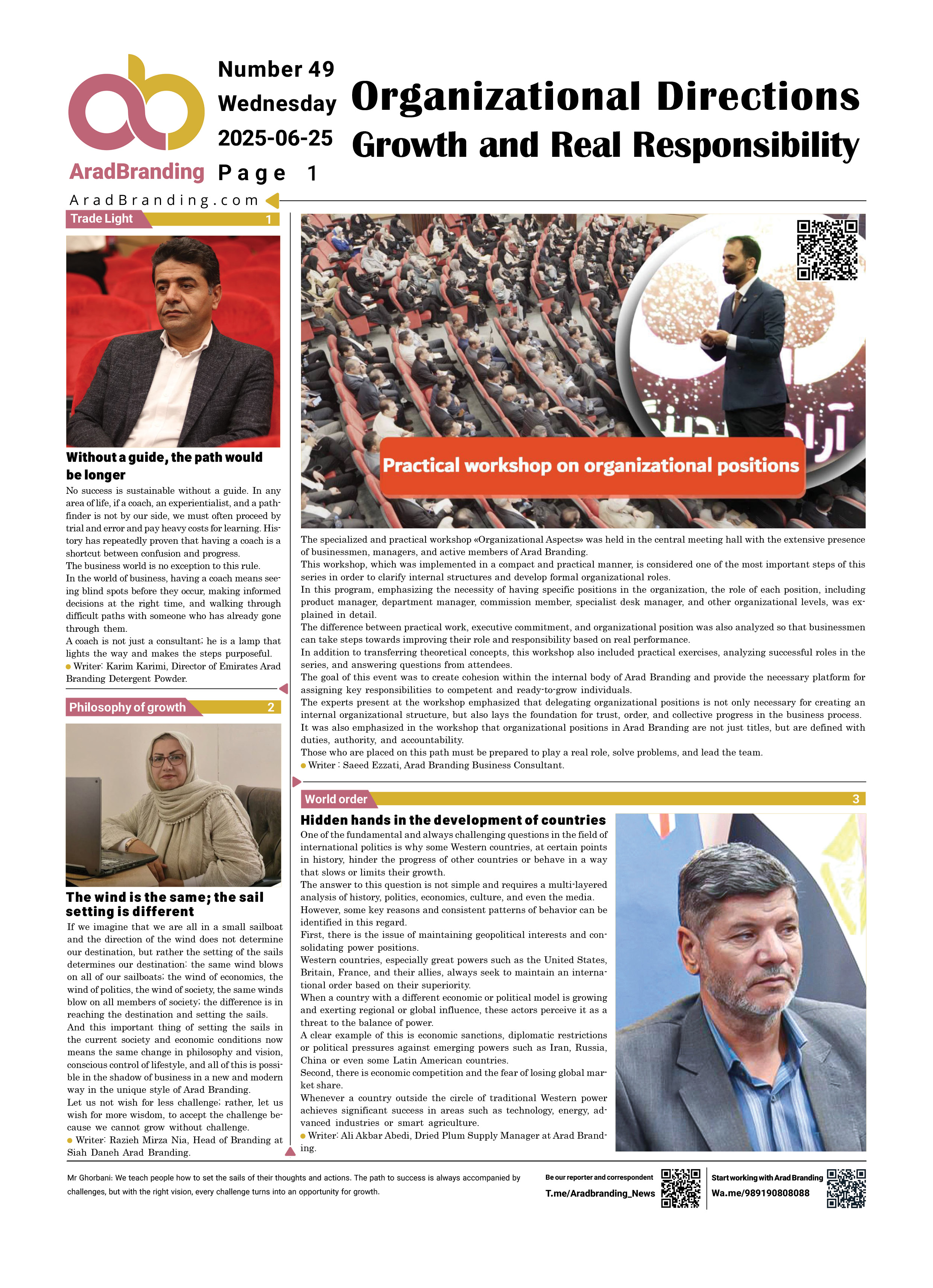
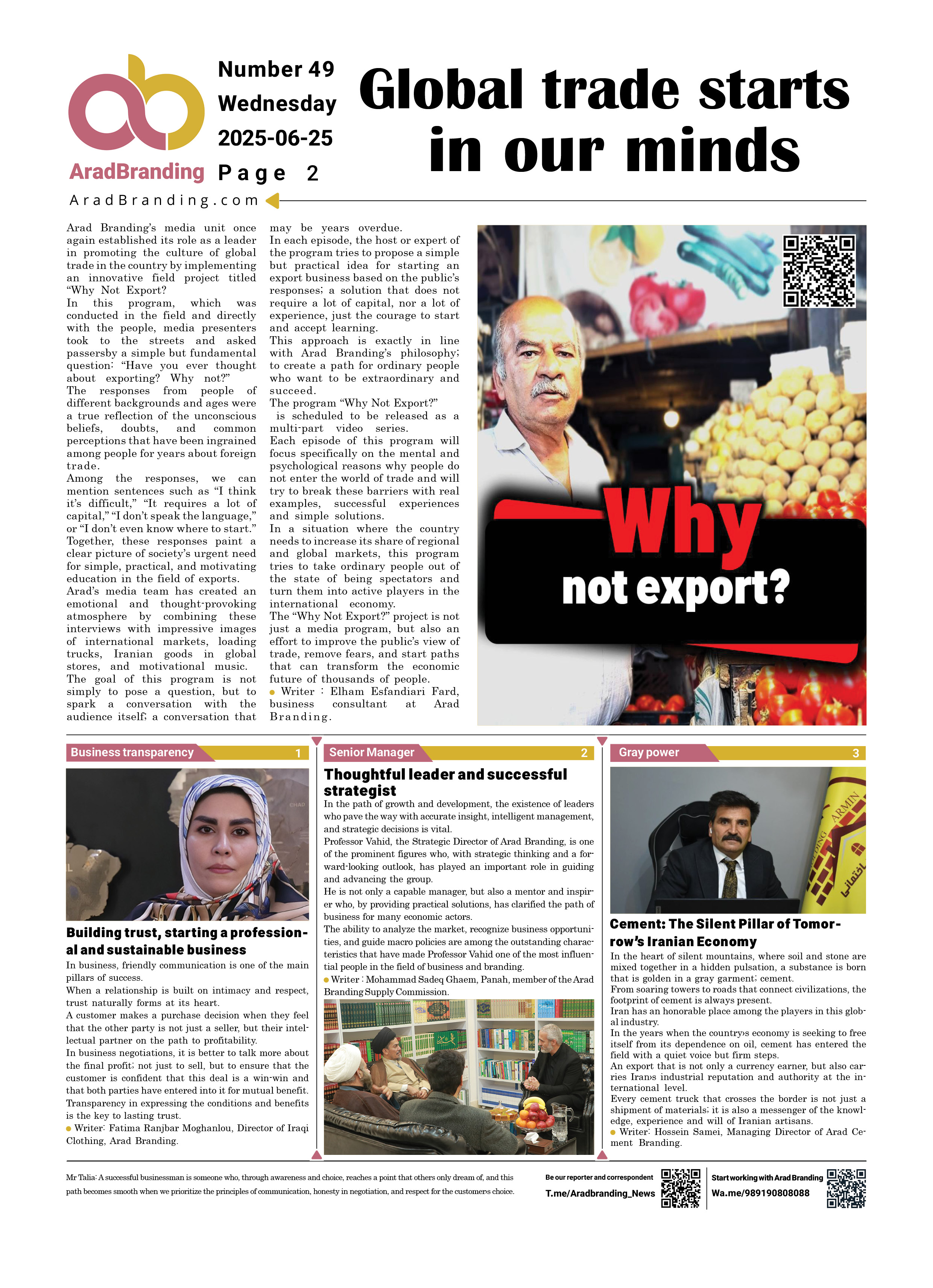
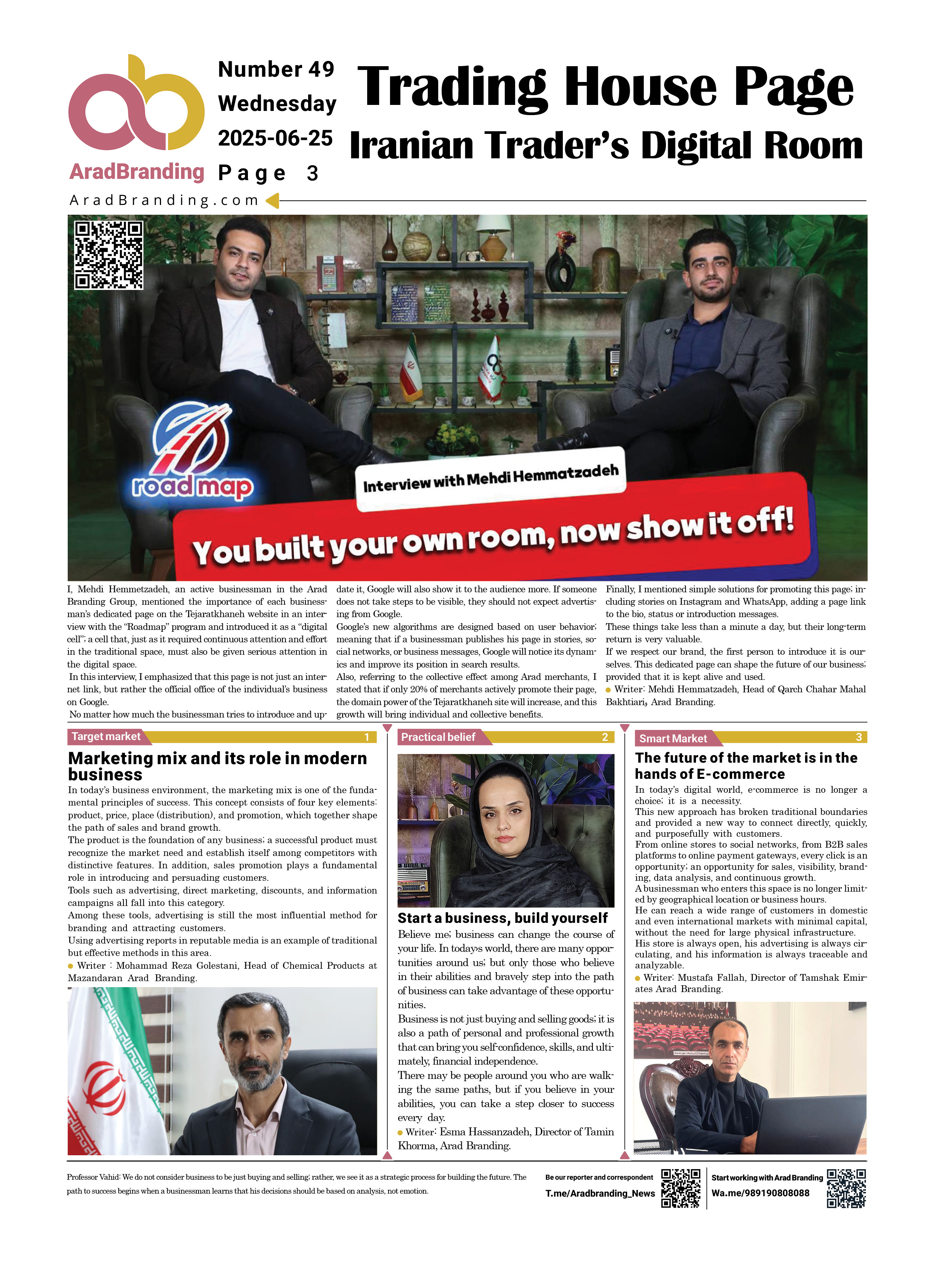
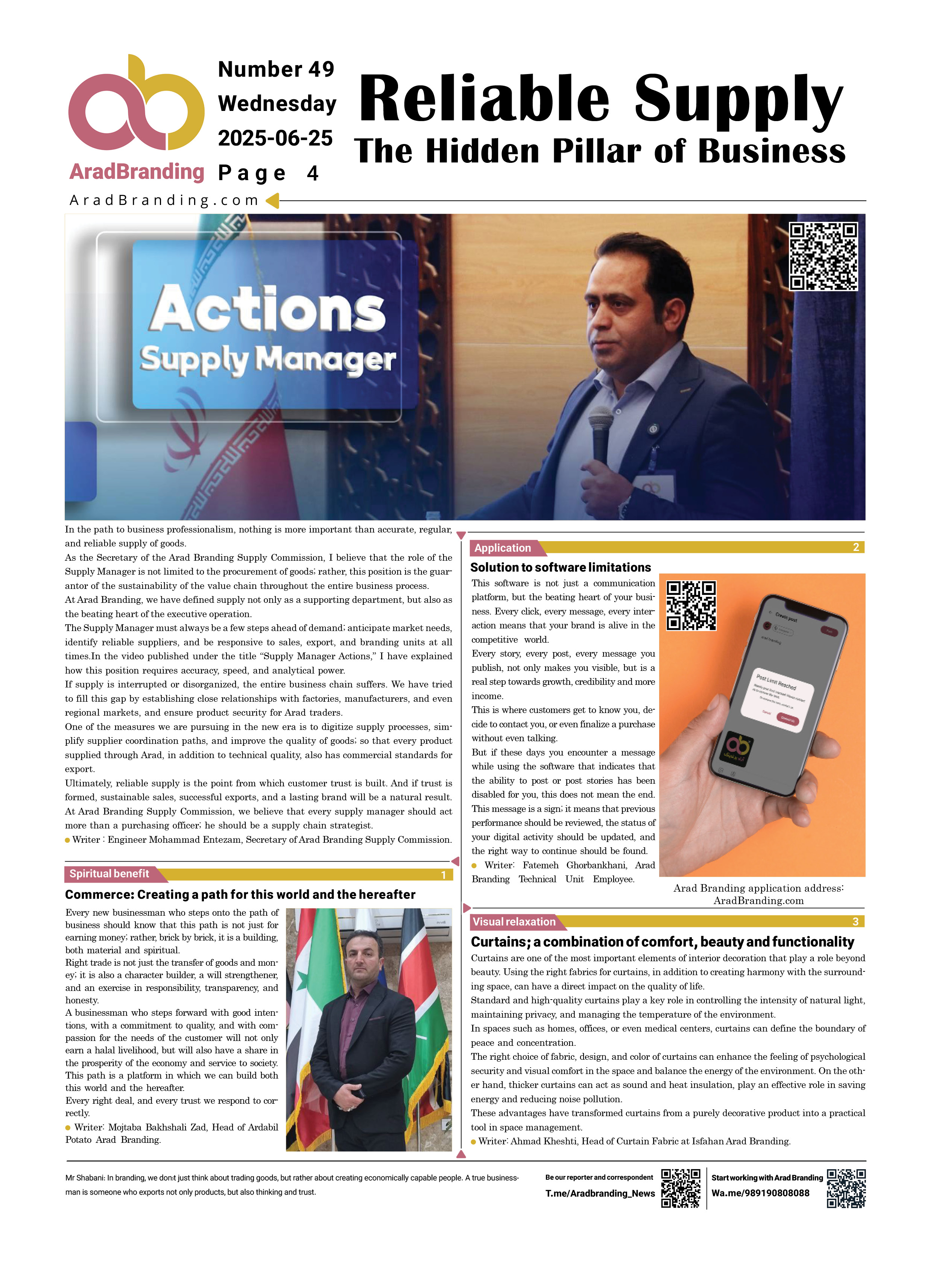
If you’d like to submit content for Arad Branding Newspaper, message the Telegram ID below.

Calligraphy by Master Mohammad‑Ali Mahjoob
Text written by AI ChatGPT